In many organisations, a successful AI pilot means the demo impressed the right people. That’s it. There’s often no production readiness criteria, no definition of what scaling it would require, no plan for what comes after this stage. Success gets declared, the momentum carries everyone into the next idea, and the first one joins a list that grows longer every quarter.
What many organisations have quietly built is a zoo. Every exhibit is well-maintained, but none of them would last five minutes in the wild where there is the complexity of real business processes and data.
Exploring the zoo
A pilot launches, gets declared a success internally, and a new one starts before anyone decides what to do with the first. Pilots get recycled under new names: the 2024 chatbot becomes the 2025 copilot becomes the 2026 agent (see how Everything is an agent now). Every one starts with a named owner and genuine enthusiasm. Most end the same way: the owner moves on, the budget runs out at the fiscal year end, and the project quietly becomes “under evaluation.” Nobody formally cancels because nobody wants to own the cancellation. It gets added to the appendix and the next round gets approved on top of it.
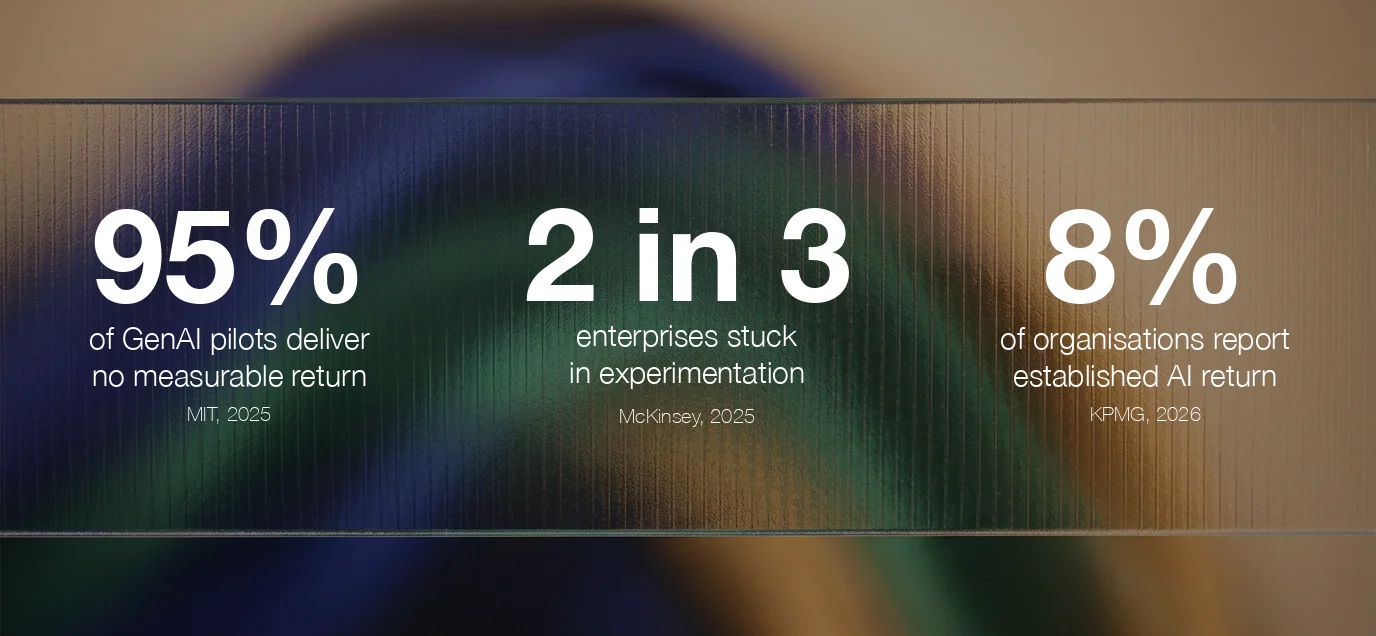
McKinsey’s 2025 research found roughly two-thirds of organisations are still stuck in experimentation, with only about a third having scaled AI across the enterprise. MIT’s analysis of around $35 billion in enterprise GenAI investment found that 95% of pilots deliver no measurable financial return. KPMG’s Global AI Pulse 2026 found that while nearly 40% of organisations are now scaling AI or driving adoption across the enterprise, only 8% report established return on investment. These get framed as proof that AI isn’t delivering. They’re really just a count of how many pilots are sitting in the zoo.
The demo problem
To be clear: demos and pilots aren’t the problem. They’re how organisations explore, de-risk, and build the case for investment. The issue is that most of the work (data, integrations, change management, stakeholder alignment) starts after the pilot succeeds, not before.
A demo is built to be convincing in the room where it’s shown. The data is carefully curated, the scope is narrow enough to work reliably, and none of the conversations that production would require have happened yet because none of them need to. The pilot gets built on the same assumptions. It looks impressive under the same controlled conditions.
When success is announced, the real work, which nobody planned or budgeted for, is just beginning. The demo showed everyone what the exhibit looks like. Nobody looked at the habitat.

The org chart
A pilot works partly because you decide who’s in the room. The scope is small enough that IT doesn’t need to sign off on the infrastructure, security hasn’t reviewed the data handling, and the teams whose workflows would need to change weren’t asked. You control the conditions.
Production is everyone and everything that wasn’t there. IT inherits infrastructure they didn’t design. The business function whose process needs to change is only now being consulted. Each of those conversations starts from scratch, and none of them were in the original plan. That’s usually what kills the momentum, and it’s rarely a technical problem.
What survives in the wild
MIT’s research found that externally sourced or embedded AI succeeds at roughly twice the rate of bespoke internal builds, around 67% versus 33%. When the AI is already embedded in the system running the process, the org chart problem doesn’t arise. The data is already governed, the process logic is already modelled, and IT doesn’t need to be won over because it’s already their system. The friction of coordinating data, IT, and process owners is lower because they are already connected in one system.
The ones that scale also almost always do the unglamorous work early: mapped and cleaned the data sources, identified the owners, had the IT conversation before it was urgent, and defined what production would actually look like before the pilot was even built. That usually means redesigning and modernising the underlying processes/business functions too- not bolting AI onto legacy architectures and hoping the AI will magically overcome existing problems.
The best enterprise AI with the higher ROI usually doesn’t look impressive in a boardroom, it processes invoices at 3am and routes procurement approvals without anyone watching.