
A demo can work with carefully chosen data, but production has to cope with the data the business actually has. NTT Data’s 2024 analysis found that between 70-85% of enterprise GenAI deployments fail to meet ROI expectations. The confident answer that impressed the steering committee turns out to have no grounding in how the business actually works. The instinct is to blame the model. Swapping a newer, larger model into a broken context architecture just gives you better prose about the wrong things.
The real issue is memory. Your AI has no structured understanding of your business: not your entities, not your relationships, not what your data actually means.
The vector soup problem
Most enterprise RAG architectures try to solve this by taking PDFs, spreadsheets, and wiki pages, slicing them into chunks, and turning them into vectors. The model retrieves whatever looks semantically similar to the query and constructs an answer from there.
This is vector soup, and the problem with the soup is that all the ingredients lose their relationships to each other.
When a model queries this way, it pulls paragraphs that look similar to the prompt but has no concept of which source is canonical, what the business entities actually are, or how they relate. Ask it about customer churn and it might pull a chunk from a sales deck and another from a finance report. If “customer” is defined differently in those files, and it often is, the model can’t tell. It merges conflicting definitions, and the answer becomes a confident-sounding hallucination.
Vector search is a retrieval mechanic, it has no understanding of structure.
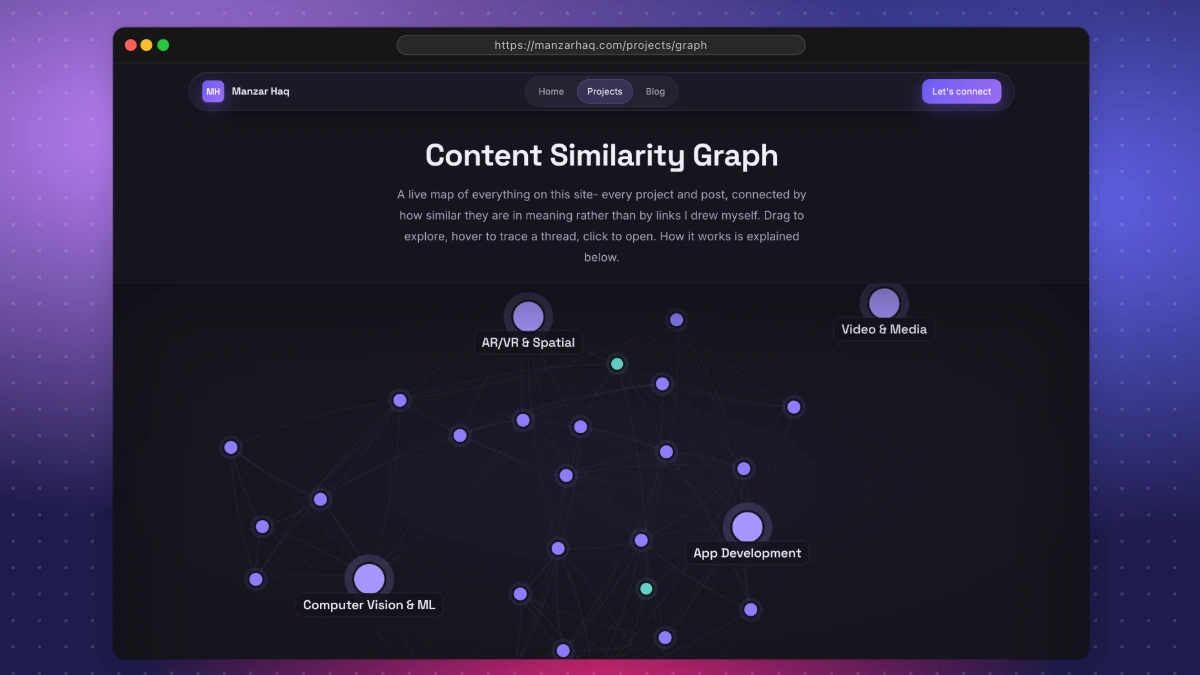
I built a content similarity graph of this very site- every post and project, linked purely by embedding similarity. It’s the “vector soup” approach made visual: no typed relationships, just “these two are alike.” Useful for exploring a simple persona site, but exactly what you wouldn’t ground a business process on.
The semantic layer
A semantic layer is a shared definition of what your business data actually means. Instead of letting the model guess what “customer” means from whatever chunks it retrieves, you define it explicitly. A Contract belongs to a Customer. A Purchase Order is raised against a Contract. An Invoice must match the Purchase Order.
This is often built as a knowledge graph or an ontology: structured memory that represents your business entities as nodes and the relationships between them as edges. The technical terms matter less than the outcome. The model has a map of your business, not just a pile of documents.
Multi-hop reasoning
When your AI has access to a semantic layer, retrieval works differently. Instead of searching for words that look similar, it traverses actual relationships.
Take a question like: “Which of our enterprise customers on legacy contracts have open critical support tickets?”
In a standard RAG system this is unreliable. The system searches for “enterprise customers”, “legacy contracts”, and “support tickets” separately, then asks the model to join them from whatever chunks came back. This is where most enterprise pilots quietly fail.
With a semantic layer, the query is precise. The model identifies the Customer node, follows the Contract relationship to verify the type, hops to the Support Ticket node to check status. The reasoning is grounded in structure, not inferred from text. One industry study comparing traditional RAG to GraphRAG on a production dataset found 80% correct answers with the graph approach versus 51% with standard vector retrieval, on exactly the kind of complex, cross-document questions that standard retrieval handles worst.
The model isn’t the problem
Most of the conversation around enterprise AI is about model selection and prompt engineering. These matter, but they’re relatively weak levers. The higher-leverage work is ontology: defining what your business data actually means and how entities connect. That work is unglamorous. It involves difficult conversations between departments that have been using the same terms to mean different things for years.
If two teams can’t agree on what a “marketing qualified lead” means, the model can’t resolve that. It will average out the ambiguity into something plausible-sounding.
The successful enterprise AI projects aren’t winning because they picked a marginally better model. They built a proper context layer first.