
Someone in 2003 figured out how to fix a bug in their home network and posted about it on a forum. Twenty years later you’re Googling a different problem entirely, and that post still shows up. Still readable, still useful, written by someone who has no idea you exist. They weren’t building a brand. They just wrote it down, and the web kept it findable for two decades.
That’s a strange and genuinely brilliant thing. A collective accidental library, built by millions of people writing for free, indexed by search engines, browsable by anyone with a connection. No subscription, no login, no algorithm deciding what you could find. You could fall into a personal blog from 2009, a forum thread from 2012, a Wikipedia edit war from 2015. It was vast and weird and full of people figuring things out in public.
That version of the web is going away.
The deal that broke
The open web ran on a simple transaction nobody really made explicit. You write something, search engines index it, people find it and click through. You get readers. Maybe ads, maybe just an audience. Google now scrapes your content, builds an AI Overview from it, answers the question directly on the results page, and the user never clicks. Chartbeat tracked referral traffic across roughly 2,500 publisher sites through 2025 and it was down 33% globally, 38% in the US. Pew Research found users are about half as likely to click any link at all when an AI Overview is present.
The content is still feeding the answer, but the visits to the publishers have mostly disappeared now.
For big publishers this is uncomfortable. For the smaller sites that make up most of the interesting web, niche blogs, specialist forums, independent Q&A communities, it’s existential. Small publishers are seeing search referrals down around 60%. There’s no business model left for writing something specific and useful in public.
Where the knowledge went
Stack Overflow is the clearest example of what this actually means. Fifteen years of developers helping each other in public, for free, building a searchable archive the whole industry quietly relied on. It logged around 3,800 new questions in December 2025, down about 78% year on year.
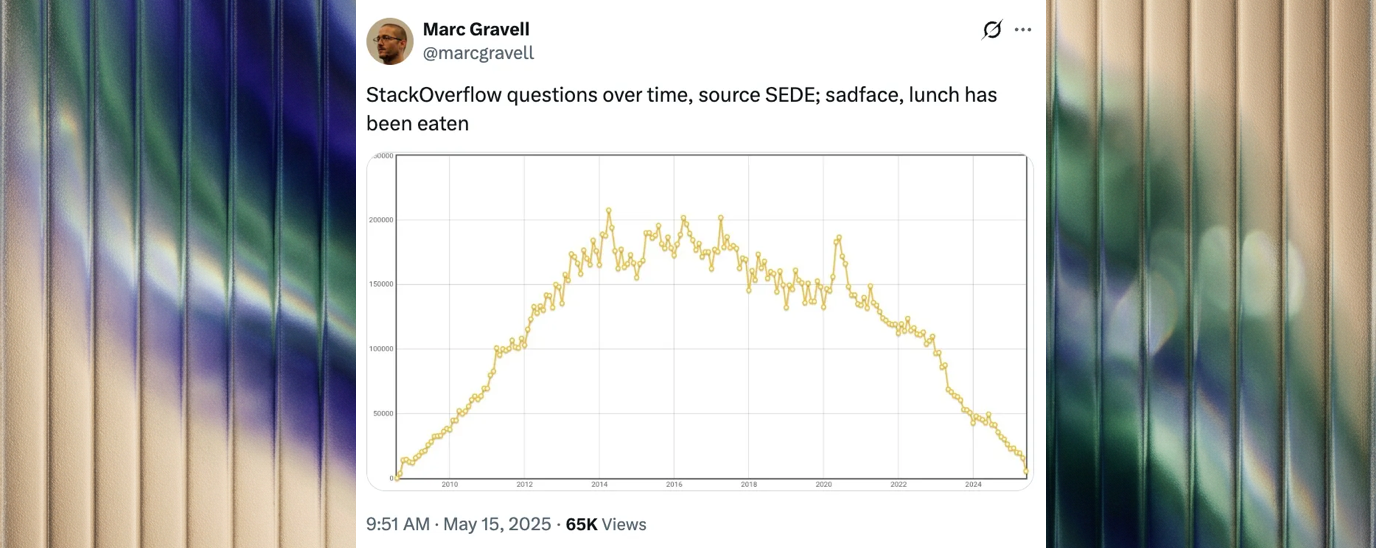
Developers aren’t posting there because they’re asking AI instead, which is fine for them individually, but the answers now live in a chat window that disappears when the session ends. The question gets answered. It just never gets written down anywhere someone else can find it.
Reddit locked its API behind expensive pricing and is suing Perplexity AI in court for scraping without paying. Cloudflare added a default block on AI crawlers for ad-supported pages. The content that used to live publicly is moving into private Discord servers, paid Substacks, gated communities. Places where there’s still a reason to write because real people are paying to read. Which makes sense. But the open, freely searchable record keeps getting smaller.
The web didn’t just stop being profitable for publishers. It stopped being a place where sharing something felt worth the effort. The blog post with the specific fix that would’ve saved someone three hours, nobody publishes it because nobody’s coming to read it.
What you’re left with
There’s a theory that’s been floating around for years called the Dead Internet Theory. The original idea was conspiratorial, that the web had been quietly taken over by bots and the real human internet had already died. Most people dismissed it. A Fortune analysis from July 2026 found that bots and AI agents now make up the majority of web traffic, citing Cloudflare data showing 57.5% of webpage requests in June were automated. About 74% of newly published web pages contain AI-generated content. Content farms are publishing thousands of articles a day, optimised to rank in searches that get answered by AI Overviews and never clicked. The open web is mostly a loop now: AI writes, bots index, AI scrapes, AI writes more.
Browse it now and it feels different from five years ago. The specific forum thread you’d have found in 2019 is buried under SEO content that looks relevant and says nothing. The personal site you’d have stumbled across is either gone or unfindable. The weird useful corner of the internet that someone built because they cared about a specific thing, that’s mostly not there anymore.
What we actually lost
The web worked for so long because of people who weren’t trying to get anything from it. Developers answering questions on lunch breaks. Hobbyists running wikis about shows that ended in 2004. People writing how-to guides for problems they’d just solved because they wished someone had written it when they were stuck. None of it was rational in an economic sense. It happened because sharing was easy and search made it discoverable and that felt like enough.
That motivation hasn’t gone away. People still want to share things. But writing publicly stopped meaning much. The audience that would’ve found your post through search is now getting a summary instead and won’t visit. Writing on the open web now mostly means writing for crawlers.
The open web wasn’t a product. It was just what a lot of people chose to do for a few decades because the conditions made it worth doing. Those conditions don’t really hold anymore, and nobody planned it that way. It’s just a lot of individually rational decisions that added up to something nobody would’ve chosen.